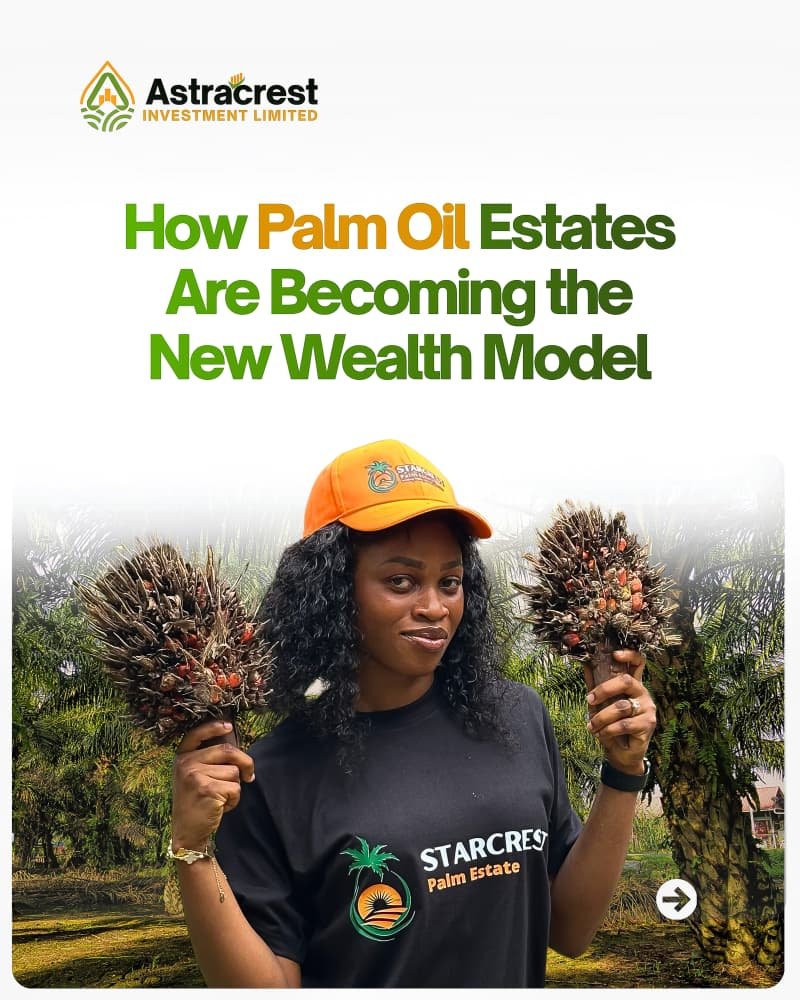
For years, real estate investors in Nigeria and across Africa focused on one thing: buying land that “just sits” and waits for appreciation. A plot today, a higher price tomorrow. It worked. But something has changed.
Smart investors are now shifting from dormant land to productive land that generates cash flow. And leading that movement? Palm oil estates.
Here’s why palm oil estates are quietly becoming one of the most powerful wealth-building models on the continent.

1. You Get Three Wealth Engines in One Investment
When you own a palm oil estate (or co-own through a structured program like the ones offered by Astracrest Investment Limited), you don’t get just one benefit—you get three:
- Land ownership – You have titled ownership of appreciating agricultural real estate.
- Passive income – Mature palms produce fresh fruit bunches every year, which are sold for consistent cash flow.
- Long-term capital appreciation – Both the land and the plantation increase in value over time.
It’s ownership + income + growth, all in one package.

2. Palm Oil Isn’t Just a Product—It’s a Global Necessity
Palm oil is in everything:
- The cooking oil in your kitchen
- The soap and shampoo in your bathroom
- The margarine, ice cream, and chocolates you love
- Even biofuels and industrial lubricants
Global demand has never faded—and it never will. According to industry reports, palm oil accounts for over 35% of the world’s vegetable oil consumption, yet it’s produced on less than 6% of the land used for oil crops. That efficiency + endless demand = permanent relevance.

3. Income from Nature Itself
Imagine owning land that literally produces money every single year—without you lifting a finger after the initial planting.
Once oil palms reach maturity (around year 4–5), they keep producing fresh fruit bunches for 25–30 years. That’s decades of harvest cycles with little additional effort. The trees do the work. You collect the income.

4. Where Real Estate and Agriculture Finally Meet
For decades, people treated real estate and agriculture as two separate worlds.
Real estate was about location, location, location. Agriculture was about hard work, weather risks, and middlemen.
Palm oil estates have torn down that wall.
You now have titled land (real estate) that comes pre-planted with a high-value perennial crop (agriculture). The result? A hybrid asset that delivers the stability of property ownership plus the cash flow of a producing farm.

5. Why Now Is the Perfect Time
- Land prices in prime agricultural zones are still reasonable—compared to what they’ll be in 5–10 years.
- Professional estate developers like Astracrest Investment Limited handle planting, maintenance, harvesting, and sales—so investors enjoy true passive income.
- Nigeria remains one of the most under-planted palm oil regions in West Africa, meaning huge room for growth.
The Bottom Line
The old model was: Buy land. Wait. Hope it appreciates. The new model is: Buy productive land. Earn while it appreciates.
That’s why palm oil estates are quickly becoming Africa’s smartest wealth model.
If you’ve been waiting for an investment that combines real asset ownership with genuine passive income and long-term growth, your wait might just be over.
The future of African wealth isn’t in empty plots anymore. It’s in plantations that pay you every year.
Ready to own a piece of the new wealth model? Palm oil estates are showing us where real wealth lies—where real estate and agriculture meet.
Contact Astracrest Investment Limited today and discover how you can co-own a producing palm oil estate with full documentation, professional management, and sustainable returns.
The harvest is ready. Are you? 🌴💰

Join The Discussion